 |
| 2025 David Hurst All Rights Reserved |
When I heard that Bachmann had produced an Emily in their N gauge Thomas range, I could not wait to get hold of one. I have always loved the Dean single that Hornby has produced for years - I had one in my early teens. My thoughts were to design a fictional 009 version, a cross between the Dean and the Sterling singles that Emily is based on, keeping that elegant Victorian look.
 |
| © 2025 David Hurst All Rights Reserved |
When my Emily model arrived, I wasted little time before it was dismantled and inspected to see how I could achieve my goal. The main chassis comprises the large central driving wheel and a smaller one in front, geared to work together. The rear wheel is non-driving with a lot of free play to allow for curved track, while the front wheel set is on a bogie incorporating the NEM coupling pocket. This allowed me to look at two arrangements: a 2-2-2 tank/tender and a 4-2-2 tender loco. Both using similar body work, just a different front foot plate.
 |
| © 2025 David Hurst All Rights Reserved |
I could see the difficult part of this conversation would be the smoke box, cylinders and piston slides, which are very small and incorporated in one moulded assembly. I could have used the existing one but that would limit the design. So, my first job as always is to get the chassis into a CAD format, then I can work round it and develop the body work. I could see that the new bodywork would need to follow the same assembly process as the original Emily and use the same fixing points and screws.
 |
| 2025 David Hurst All Rights Reserved |
The first part to tackle was the smoke box and cylinders. I worked on this to achieve a good fit to the chassis first, developing the shape to match the existing Bachmann parts, then I designed an outer shape to get the feel I was looking for in 009 scale - something very similar to the Sterling, a nice flowing shape between the cylinders and smoke box. The difficulty with this part was adding the wire guides for the cross heads in 0.4 mm wire on either side of a 0.7mm hole for the piston rod. After several attempts at printing these, the best solution was to have a pilot hole for the piston only printed in the part and free hand drill the holes for the guides above and below the piston. It is still a fiddly job, and I wasted several printed parts getting it right. This was confirmed by A fellow 009 modeller, who has also worked on another copy of the model and found it difficult to drill the holes to fit these wires in place. The other option is to use the current Emily smoke box and extend the funnel. However, this does not align with the new boiler profile.
 |
| © 2025 David Hurst All Rights Reserved |
The coupling rods need removing from the large driving wheels to make it easier to locate and fit the cross heads to the guides. A very small bolt is used to fasten the rods to the centre of the driving wheels which is a fiddly job to put back in place.
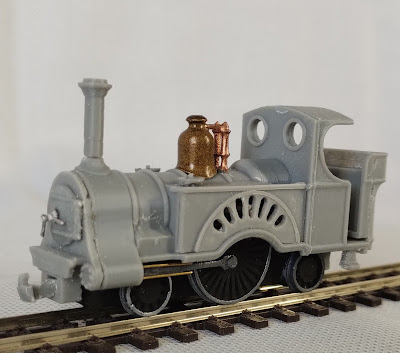
When I had the smoke box fitted to the chassis and the piston working freely, I then tested the chassis running it on a test track. The next task was to deal with its main body design. This is where I planned to blend the Sterling and the Dean together. My aim was to have the fretwork showing the large wheels like on the Stirling, with water tanks to the front and back of this, on the 2-2-2 tank engine. The tender loco would have large curved shrouds built up to the rear of the splashers back to the cab front, with the top of the boiler and the cab being similar to the Dean with the brass dome and curved cab side cutouts. The back of the cap would remain open, and I would add some simple printed details to the interior, with other fine detailing added in metal parts. I used an etched fret from RT Models to do this, which has various gauges and valve handles. The regulation was made from 0.7mm wire filled to shape.
To get the tank engine version of the model to work I needed to add a coal bunker to the rear foot plate somehow. As the cab was coming out a bit higher than I wanted, I lowered the back of the foot plate by 1.5 mm. By dropping the cab down the same amount, I then could use this to add a plate on top of the cab floor, like a step within the cab but as part of the bunker assembly. The bunker itself was modelled on an older pannier tank engine - the open cab type. This has a nice shape matching the Dean styling of the cab and can easily be added to the cab to form a very different version of the engine.
 |
| © 2025 David Hurst All Rights Reserved |
The front foot plate has two versions: one suits the chassis without the front bogie wheel, being short and having a coupling pocket below the front beam. It is all printed as one with the front of the smoke box.
 |
| © 2025 David Hurst All Rights Reserved |
The other is longer and uses the current n gauge NEM coupling pocket in the bogie, which is ideal to add 009 style couplings.
 |
| © 2025 David Hurst All Rights Reserved |
I have made several detail parts separately to allow some variations to be added to each model. The funnel can be cut to different lengths. The dome is printed, but I used a nice cast brass one again from RT Models. The water tank filler caps are printed, but again white metal one could be used. There is a separate smoke box door with a pilot hole for darts to be added. This was another part from RT Models. I have also printed a reversing leaver to add inside the cab.
 |
| © 2025 David Hurst All Rights Reserved |
The tender I have used is an adaptation of a general 009 one that has been designed for some of my other models. It is a 4-wheeler using a Peko R106 wagon bogie with a 3D printed body and foot plate. The design of the upper body has been adapted to align with the new engine style and a simple drawer bar and pin is used to connect it with the locomotive - like the current Emily one, but this time in Plastcard. I printed a break handle column to which I added a handle using a small handrail knob and a handle bent from 0.45mm wire. To fall in line with the Victorian tender style I added a wire guard rail around the sides and the back of the upper edge of the body work made from very fine 0.45mm brass wire bent and super glued into place.
 |
| © 2025 David Hurst All Rights Reserved |
For the colour scheme of this model, I want to match my current 009 Beyer Peacock in the older GWR livery for the tender loco and a mustard for the tank engine. I found some Vallejo acrylic paints in green and red that meant I would not need to mix the colours this time giving a more consistent finish. So, having fitted the brass components, I primed the model in a combination of Tool Station rattle can acrylic grey primer and clear gloss lacquer, built up in alternate coats to smooth the surface before the final hand brushed finishes which are thinned with Vallejo acrylic thinner medium. This allows a better flow off the brush and dries slower allowing it to level and not show brush marks.
Once I had applied a few coats, I added 0.35mm cream lining by Fox Transfers to form panels on the tender and cab and banding on the boiler. I also hand-painted the large wheel splashers in a matching cream.
To allow me to at least display the other version of the model as the chassis is not cheap, I used the chassis drawings to create a print of both the 4-2-2 and 2-2-2T as dummy chassis.
 |
| © 2025 David Hurst All Rights Reserved |
I asked a fellow 009 modeller to have a go at building a model to see if they encountered any issues. They concluded that drilling the two fine holes for the guide wires was their main difficulty, but it may be easier to achieve on a drill stand.
 |
| © 2025 Hugh Norwood All Rights Reserved |
It is extraordinary to think that someone may have built something like these singles in narrow gauge, but a fellow 009 modeller on Facebook noted that three narrow-gauge singles were commissioned for the Glasgow Garden Festival 1988. They were built by Severn Lamb Ltd based on the Caledonian Railway 4-2-2 Locomotive no 23, and were diesel driven by the tender. Apparently, at least one of them has been sent to Japan and used in the Rusutsu Resort there.
 |
| © 2025 Open image All Rights Reserved |


